Tuesday, August 23, 2016


BULLWINKLE’S GONE WILD!


Moose shedding its antler’s velvet
Photo credit: arkive.org Tome & Pat Leeson

The Algonquin Indians called this animal Mooswa, which means ‘twig-eater,’ or one who strips bark from trees. The Moose is the largest animal in North America, and it is a deer—the largest deer in the world. Moose can stand 6.5 feet at the shoulder and weigh as much as 1800 pounds. For all this size and bulk, they are fast on their hooves and can reach speeds of up to 34 mph. Moose are also great swimmers and have been known to swim ten miles or more.


Photo credit: National Geographic


Photo credit:  Brad Starry, Your Shor (National Geographic)

They look similar to a deer, but their antlers set them apart. The antlers of a Moose are broad and flat and can spread six feet from end to end. Each winter the antlers are shed, and they regrow in the spring.

Photo credit: Douglas Lloyd (mooseworld.com)

 The Moose has a long face. Its muzzle hangs over its lower lip, and a flap of skin hangs from its neck. This flap of skin is sometimes referred to as a dewlap or bell. Scientists are not clear on the function of this loose hanging skin.

Image credit: iStock

To fuel their massive bodies, Moose have to eat a lot. Their diet varies depending on the season, availability and geography. They are herbivores, and that means they will consume mass quantities of greens; approximately 73 pounds per day, less in the winter. When the pickings get lean, they will strip bark from trees and eat that. 

Because they are so big and need so much food to survive, Moose have evolved an unusual ability that no other deer possess. They suppliment their diet with plants that grow in the water. Moose are excellent swimmers and can dive to depths of 16 feet to reach aquatic plants. To do this, they have evolved nasal valves which close, so water does not get into their air passages. Amazing!

I found an excellent video that shows how Moose live symbiotically with beavers. A symbiotic relationship is an interaction between different species. It can be beneficial as well as detrimental. However, in many cases, symbiotic relationships provide a needed balance in an ecosystem. Take a moment to check it out.


Oh, and here’s another odd thing about Moose, they can move each ear and each eye independently. Here's looking at you...no, at you. Uh...

Finally, no need to worry, this animal is not endangered. As a matter of fact, Moose are very adaptable even to environmental changes. 
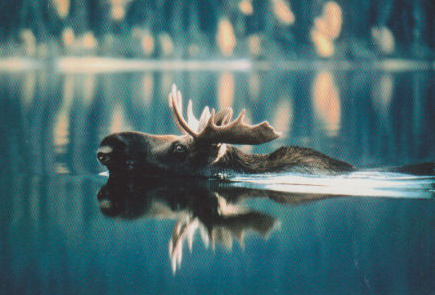
Photo credit: Yvonne Cooper – flickr.com


If you’d like to learn more about this fascinating creature, visit the following sites:


Thank you so much for stopping by, and I hope to see you again next week. Feel free to leave a comment and to share the post with friends and family. It’s truly appreciated.

Enjoy!

Jeanne E. Rogers, Author
The Sword of Demelza, The Gift of Sunderland, and
One Hot Mess, a Child’s Environmental Fable
Award Winning Middle-Grade Fantasy, Where Endangered Animal Heroes Roam the Pages!


Tuesday, August 16, 2016

JUNGLE CHICKEN!
By J.E. Rogers

It’s been two weeks since I’ve posted to the Aussie blog. I took a vacation, and it felt good, but now it’s back to talking to you all about those unusual animals that inhabit planet earth.

While paging through one of my many volumes on animals, I came across this critter, and my first reaction was, ‘it’s a chicken!’ It’s not a chicken at all. As a matter of fact, scientists tried to classify this bird with cuckoos, pheasants, pigeons, and turacos, but that didn’t work so they created a classification specifically for it—Opisthocomiformes, which means strange comb-like hair. Well, let’s take a look.


Meet the Hoatzin!

Photo credit: La Selva Lodge, Ecuador, January 2009

Yup, that’s some very strange hair.

The Hoatzin is native to the Amazon. It is found in the lowlands of northern South American and throughout Amazonia. It is a pheasant-sized bird with a total length of approximately twenty-six inches. It has a long neck, a small head with a crest, an unfeathered blue face and maroon eyes.  

Photo credit: Wikipedia


These birds are not good fliers and therefore are not migratory, preferring a sedentary life in trees. Their attempts to fly sometimes end with a crash landing. Found by rivers, Hoatzins will build their nests in trees overhanging the water. If a predator attacks a nest, the chicks will drop out of the nest to the water and will climb out of the water with the use of ancient claws on their wings. It’s hard to imagine, so take a moment to check out this video:


The Hoatzin is the only bird that has these unusual claws. However, the claws are only seen in the chicks, and they disappear as the young bird matures. To read more about claws on the wings of birds, visit this site: http://scienceblogs.com/tetrapodzoology/2010/06/30/clubs-spurs-spikes-and-claws/

This video provides information about the Hoatzin and the extraordinary claws that are found on chicks.


Hoatzin chick – Photo credit: National Geographic

Some scientists believed that the Hoatzin is somehow related to the now extinct Archaeopteryx. Looking at renderings of the Archaeopteryx, like the one below, might bring anyone to the same conclusion. In 2015, genetic research on the Hoatzin was conducted.


It was discovered that it is the last surviving member of a bird line that branched off into a separate direction about sixty-four million years ago. (https://en.wikipedia.org/wiki/Hoatzin)

Photo credit: Animal Kingdom Magazine (Animal Planet)

The Hoatzin is also known as the ‘stink bird.’ He got this nasty moniker because he likes to eat a lot of greens and store it in his crop. A crop is a pouch in the throat that aids in digestion. The crop of the Hoatzin is fifty times the size of his stomach. The chewed leaves sit in the crop and begin to ferment, which causes a stench. The result is a horrid smell much like that of manure. Seems that the name ‘stink bird’ is well applied.

Finally, here is a very short video. I think it’s wonderful because it is a close-up of a single bird displaying his beautiful feathers for us as he struts along a branch on a river. Take a moment to watch.


To learn more about the Hoatzin, visit the following sites:


Taking a Sip
Photo credit: Animalworld.tumbler.com

Oh, one last thing. I am thrilled to announce that the beautiful Hoatzin is not endangered.

Thank you for visiting, and do come by again next week. Don’t forget to leave a comment or share my post.

Jeanne E. Rogers, Author
The Sword of Demelza, The Gift of Sunderland, and
One Hot Mess, a Child’s Environmental Fable
Award Winning Middle-Grade Fantasy, Where Endangered Animal Heroes Roam the Pages!


Wednesday, July 27, 2016

ORANGE-BELLIED PARROT
By J.E. Rogers


Indigenous to Australia, the Orange-Bellied Parrot is critically endangered. This colorful parrot belongs to a group of parrots called Neophema. Neophema is an Australian genus of parrot. There are six species in the genus, and they are all small and are also known as grass parrots. Males and females have the same coloring, but the male tends to have brighter hues.


This beautiful parrot, as its name indicates, has an orange belly, blue tipped wings and green feathers over its back. The males are easily identified by the bright blue band above their nose.

When this parrot is alarmed, it gives off a metallic buzzing sound and can fly straight up from the ground. The parrot prefers to forage on the ground, so this flight up from the ground is an exceptionally good defense mechanism.

The parrot is critically endangered as a result of habitat destruction. Their habitat has been continually depleted due to urban development and farming expansion.


Although it was once widespread across Australia, it is now confined to a small strip of land in southwest Tasmania.


Approximately 75 acres has now been set aside by the South Australian government in an effort to preserve the habitat for the Orange-bellied Parrot. Ian Hunter, the Minister of Environment and Conservation, has said, "It's been long known to be a vulnerable population and linking up areas of habitat give it the best possibility of maintaining its nesting sites. It's very important that we can actually consolidate these areas of protected reserves so we actually increase its range and increase its ability to produce young in the wild."

The Australians view this parrot as a treasure. I am certain they will do their level best to ensure the survival of this beautiful bird.

To learn more about what the government of Australia is doing, visit this site:

To learn more about the Orange-bellied Parrot, visit these sites:

Here’s a very short video which shows what is being done to help the existing population of Orange-bellied Parrots.


I hope you enjoyed this week’s short post. I also hope that you will leave a comment and share it. Thank you for stopping by, please do so again. 

Jeanne E. Rogers, Author
The Sword of Demelza, The Gift of Sunderland, and
One Hot Mess, a Child’s Environmental Fable
Award Winning Middle-Grade Fantasy, Where Endangered Animal Heroes Roam the Pages!


Wednesday, July 20, 2016

LET’S GET WEIRD!

I’m always trying to find something unusual in the animal kingdom to blog about. This is not a difficult task considering how many different creatures inhabit our planet. So this week let’s take a look at the numbers and once we do, let’s point out some wild, weird, and wonderful facts.

First of all, did you know that there are over 6.5 million species on land and 2.2 million in the depths of the ocean? That’s a lot of living things, and some of them are truly strange and unusual.


For instance, the cow. Yes, the ordinary cow that roams in green pastures. Cows are very particular about how they eat. Specifically, cows will align themselves in a north-south direction when the graze. Why? Well, scientists are not sure, but they like to give us answers, and they attribute this activity to the earth’s magnetic field. It is now admitted that many grazers, not just cows, exhibit this same behavior. Um…?


To read more about this unusual phenomenon, visit this site: http://news.bbc.co.uk/2/hi/science/nature/7575459.stm


Okay, next fun fact. Did you know that dolphins call each other by name? I didn’t! I think it's interesting that we know they are calling each other by name?  How do we know that? It seems scientists have found that there is a particular whistle attributed to each dolphin. Their specific whistles help them to stay together as a group.

Photo credit: Chicago Zoological Society


To read more about dolphins and how and why they call their dolphin friends, visit this site:


Did you know that tardigrades are extremely durable? They exist all over the Earth and are capable of surviving in temperatures from highs of 300 degrees to lows of -458 degrees. They can even survive in the vacuum of space. What’s more, they can exist without a meal for ten years. Oh, you don’t know what a tardigrade is or what it looks like? Here you go.


To learn more, visit this site, you’ll even see this little microscopic animal walking. It’s quite interesting.


Human males go to great extents and expense to propose marriage to another human. Did you know that the Gentoo and the Adelie penguins propose by offering a pebble to the female of their choice? Well, that's romantic.  It’s not the same sort of rock that humans expect. I guess it’s the thought that counts.


To learn more about this romantic behavior, visit this site:


Here are a few weird facts for you:
  • A group of parrots is called a pandemonium.
  • A group of ravens is called a murder.
  • Polar Bears have black skin.
  • Honeybees can flap their wings over 200 times a second.
  • Bats are good guys. By eating insects that are considered pests, they save the US agriculture industry an estimated three billion dollars a year.


Okay, two last little ditties and they have to do with music.

Fourteen new species of dancing frogs were discovered in 2014.
This is a wonderful video about the dancing frogs of India. I hope you take a few minutes to watch it.


Finally, the only mammal that has been found capable of keeping a beat is the sea lion. For this, we’ll have to watch a video. It’ll be fun! Watch it!


I do hope you enjoy reading this week’s post as much as I did in creating it for you.

Be sure to stop by again next week, and don’t forget to share! Thanks so much.

Jeanne E. Rogers, Author
The Sword of Demelza, The Gift of Sunderland, and
One Hot Mess, a Child’s Environmental Fable
Award Winning Middle-Grade Fantasy, Where Endangered Animal Heroes Roam the Pages!


Wednesday, July 13, 2016

Queen Alexandra’s Birdwing Butterfly


The largest butterfly in the world is endangered. It’s called Queen Alexandra’s Birdwing Butterfly. This magnificent butterfly was discovered in the early 1900s by Alfred S. Meeks. Meeks named the butterfly to honor Queen Alexandra, the Danish wife of King Edward VII of England (1841-1910).

Photo Credit: Steve Parish (https://www.steveparish-natureconnect.com.au)

This beautiful butterfly is sexually dimorphic, which means the male is prettier than the female. This is often the case in nature. In the below picture, the female is at the top… brown with spots. The male at the bottom is a bit more glorious.


It is endemic to a small lowland portion of the rainforest in Papua New Guinea. There are a number of so-called ‘birdwing’ butterflies, but the Queen Alexandra’s is the largest, having a wingspan of up to twelve inches.


Not only is the butterfly beautiful, but the caterpillar stage also dons beautiful red spikes on black with a central spike of yellow. The contrast is spectacular. Also, as is usual in nature, this bright coloring serves as a warning to potential predators–don’t eat me, or I’ll make you sick. 


So how does a butterfly become poisonous? Good question. Like many other poisonous creatures, the butterfly becomes toxic just by eating. In the case of Queen Alexandra’s Birdwing, their home is lethal. The female of the species lays its egg on the leaf of the pipevine plant, which leaves contain a toxin. The caterpillar hatches from the egg and immediately begins chomping on its home and as a result, becomes poisonous. As it grows, the caterpillar molts, eventually morphing into a pupa then into a butterfly, a toxic butterfly.

Queen Alexandra’s Birdwing is endangered (IUCN*) due to habitat destruction. It is now confined to approximately sixty-two square miles of coastal rainforest in Papua New Guinea. The habitat is being taken for palm oil plantations. It is illegal to trade this butterfly internationally.

Although this video won’t show you the scale of this Queen Alexandra’s Birdwing, it is nevertheless beautiful.


So lastly, I thought we might just mention the differences between butterflies and moths. It’s easy to tell them apart. Although both of these groups of insects are members of an order called Lepidoptera, they have significant differences.

A moth’s cocoon is spun silk. It’s a soft little bundle. A butterfly forms a chrysalis. It has a hard exterior. Both are the insect’s temporary home as the undergo a transformation from larvae to caterpillar. The butterfly’s antennae are thin with a thick tip. The moth’s antennae are feathery. Butterflies have colorful wings, and a those of the moth are less dramatic. Another interesting feature is the way they hold their wings. Butterflies tend to fold their wings straight up while moths hold them in a tent-like fashion.


There is always an exception to the rule, and it’s no wonder that the exception lives on the island of Madagascar—the Madagascan Sunset Moth. This moth his beautiful pigmentation. We have learned in past blog posts, and I have also mentioned it above, that sometimes a colorful creature comes with a warning. This particular insect is no different. It is poisonous. Oh, and one more thing about this exceptional moth. It’s diurnal, which means it’s active during the day, and that’s atypical moth behavior.

Photo credit: Biobunch.blogspot.com

Visit the following sites to learn more about Queen Alexandra’s Birdwing, and moths.


I hope you enjoyed this week’s post, and I hope that you will come back again next week for a look at another unusual creature.

IUCN = International Union for Conservation of Nature 

Enjoy!

Jeanne E. Rogers, Author
The Sword of Demelza, The Gift of Sunderland, and
One Hot Mess, a Child’s Environmental Fable
Award Winning Middle-Grade Fantasy, Where Endangered Animal Heroes Roam the Pages!